

200 Leaders Convene in Madison to Advance Markets for Working Forests and Rural Communities
Markets Matter Convening to identify practical actions to strengthen forest product markets and inform a National Action Plan
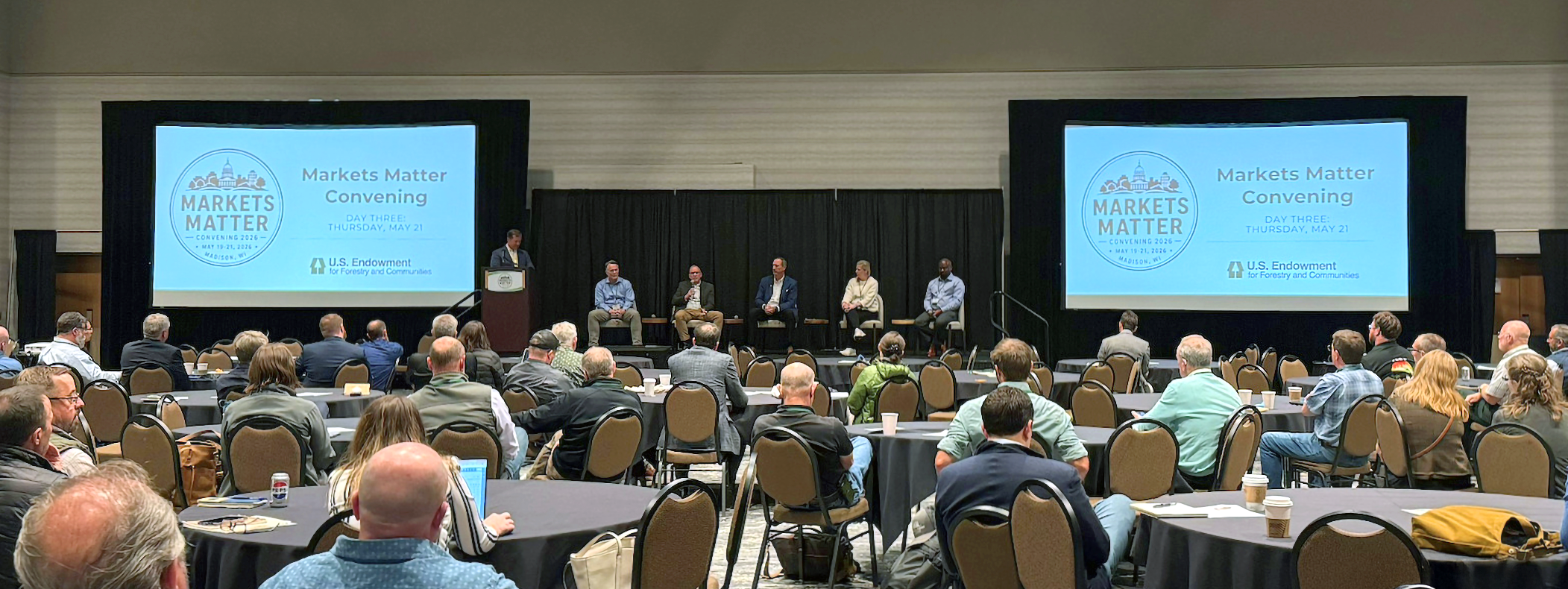
More than 230 leaders from across industry, government, investment, Tribes, research and nonprofits gathered in Madison, Wisconsin, last week for the Markets Matter Convening, hosted by the U.S. Endowment for Forestry and Communities. The three-day convening, held May 19–21, focused on identifying practical actions to build markets for small diameter wood, manufacturing residues and residual wood fiber — findings that will inform a National Action Plan to be developed in the months ahead.
The convening comes at a critical moment for the U.S. forest sector. Traditional wood-consuming industries continue to face pressure, and mill closures are already reshaping regional supply chains. Since 2015, more than 40 pulp and paper mills have closed, eliminating an estimated 60 million tons of annual demand for wood from forest regions across the country. A new economic analysis commissioned by the Endowment and conducted by AFRY Management Consulting finds that additional pulp and paper capacity remains at risk in the years ahead.
For working forests and the communities that depend on them, the effects extend well beyond any single facility. When markets for lower-value wood — including chips, sawdust and other byproducts — weaken, landowners have fewer economic reasons to keep forests actively managed, sawmills lose important revenue streams and rural communities feel the strain across jobs, infrastructure and local tax base.

Pete Madden
President & CEO of the U.S. Endowment for Forestry and CommunitiesThe Markets Matter Convening was designed to meet this challenge head-on by identifying the coordinated action needed to grow reliable demand for wood products, strengthen forest markets and support the communities that rely on them.
Over three days, working groups identified priority market opportunities, barriers to investment and specific actions that can move forward through cross-sector collaboration. The insights and commitments from the convening will inform a National Action Plan to be developed this summer, establishing near- and long-term recommendations across market development, capital investment, policy and workforce.

Tom Schultz
USDA Forest Service ChiefThe Endowment is committed to bringing additional attention and resources to this critical issue and announced it would be committing $10 million over the next three years to help attract additional investment to the sector and continue to pursue emerging markets to help keep our forests and communities healthy and sustainable. Additional details on the convening’s findings and the development of the National Action Plan will be shared in the months ahead.
About the U.S. Endowment for Forestry and Communities:
The U.S. Endowment for Forestry and Communities is a not-for-profit public charity collaborating with partners in the public and private sectors to advance systemic, transformative, and sustainable change for the health and vitality of the nation’s working forests and forest-reliant communities. To learn more about the Endowment, please visit our website at www.usendowment.org.