

U.S. Endowment for Forestry and Communities Highlights First Nanocellulose Spillway at Wildwood Farm in Georgia
Photo credit: U.S. Endowment for Forestry and Communities
Reducing environmental impact of concrete while demonstrating the versatility of renewable forest products
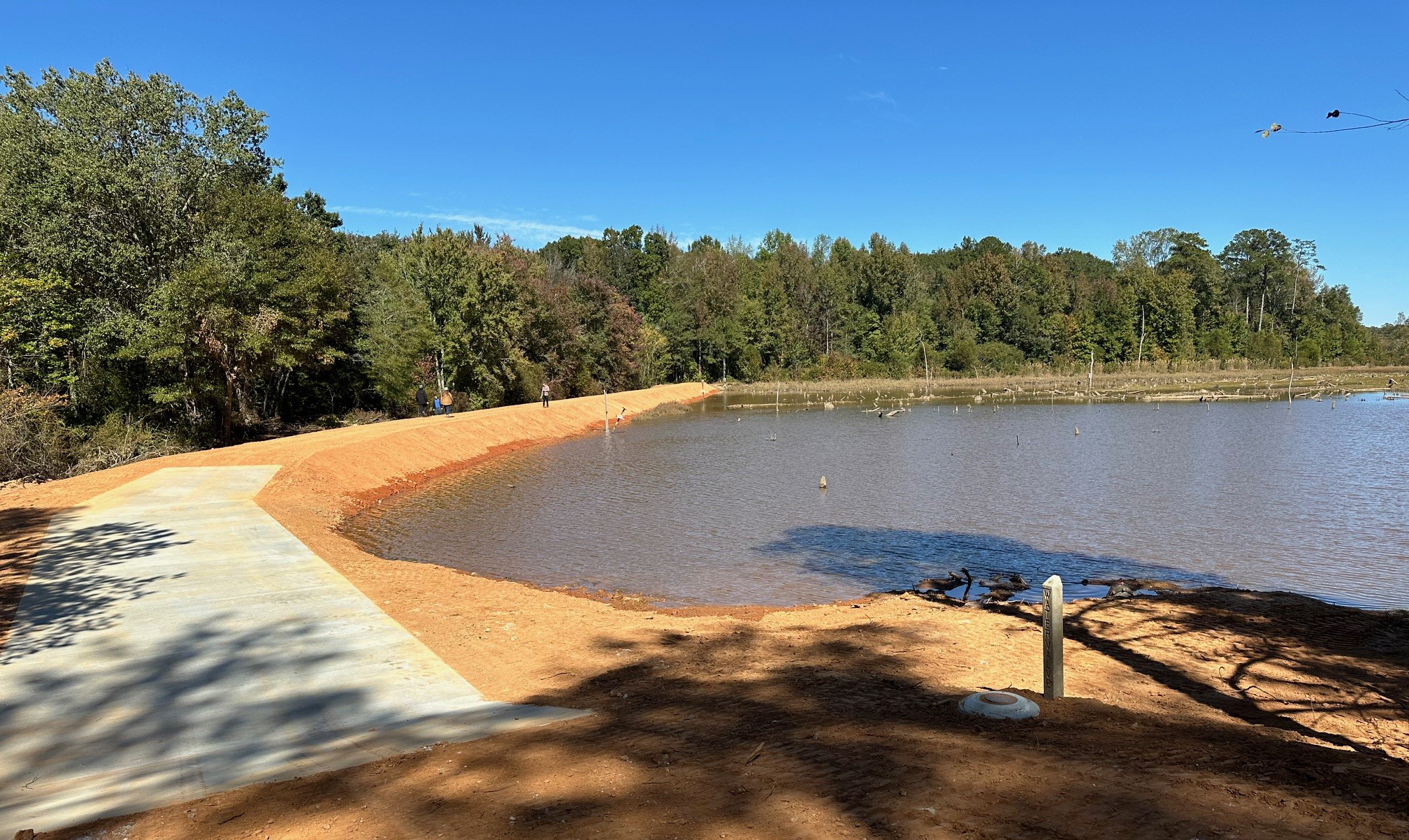
The U.S. Endowment for Forestry and Communities (the Endowment), in partnership with the USDA Forest Service and the Forest Products Laboratory, recently completed the first dam project to use a nanocellulose enhanced concrete mixture, representing a critical step forward in proving the material’s durability in constant exposure to running water and the elements. The spillway marks the largest nanocellulose-concrete pour to date, requiring 100 pounds of nanocellulose, and is located at Wildwood Farm in north Georgia. Wildwood Farm is owned by Derek Trucks and his wife, Susan Tedeschi.
Nanocellulose is used as an additive to concrete, which is a mixture of water, cement and aggregates such as sand and gravel. The cement acts as a binder, and its hydration reactions are enhanced by the nanocellulose additions, resulting in improved strength and durability of the concrete. This allows the final concrete mixture to use less cement while still meeting property requirements. Because cement production requires a large amount of energy, nanocellulose additions can reduce the overall energy requirements and lower the greenhouse gasses produced in concrete applications. With abundant supplies of low-value wood available in U.S. forests, nanocellulose also creates a path toward more resilient forest-based economies.

Alicia Cramer
Chief Operating Officer at the U.S. Endowment for Forestry and CommunitiesThe Wildwood Farm project underscores the catalytic role of public-private partnerships in scaling environmentally responsible innovation. By demonstrating performance of nanocellulose-concrete formulations in challenging applications like a dam spillway, the Endowment and its partners are helping to pave the way for wider commercial adoption by concrete manufacturers and construction stakeholders worldwide.

Robert Moon
Materials research engineer at the U.S. Forest ServiceRecent demonstration projects funded by the Endowment and the Forest Service to commercialize wood-based nanomaterials include a sidewalk at the Forest Products Lab in Madison, Wisconsin, a parking lot in Greenville, South Carolina and a bridge in Yreka, California.
About the U.S. Endowment for Forestry and Communities:
The U.S. Endowment for Forestry and Communities is a not-for-profit public charity collaborating with partners in the public and private sectors to advance systemic, transformative, and sustainable change for the health and vitality of the nation’s working forests and forest-reliant communities. To learn more about the Endowment, please visit our website at www.usendowment.org.